

Many patients who suffer from persistent or recurring musculoskeletal problems are looking for additional ways to relieve their pain. Kinesio taping is a very good additional option. The method has been scientifically studied for years and has been shown to have positive effects on selected symptoms, especially in combination with active treatment approaches. Everything you need to know about Kinesio tapes is explained below.

What are Kinesio tapes?
These are elastic, self-adhesive cotton tapes that we apply directly to your skin. Their structure is similar to human skin in terms of elasticity and resilience. This allows the tapes to adapt to the body’s natural movements without restricting them.
In orthopaedics and sports medicine, Kinesio tapes are used to provide functional support for muscles, tendons and joints. Kinesio tapes perform different tasks depending on how they are applied, the direction of pull and their position. They do not replace medical treatment, but complement it as part of a holistic therapy concept.
What do the colours of Kinesio tapes mean?
Blue, red, beige, black – the tapes are available in different colours. However, the choice of colour has no bearing on the medical effect. The material, elasticity and adhesive properties remain the same regardless of the colour, as does the functional effect on muscles and joints.
Although some concepts associate certain colours with warming or cooling properties, there is no reliable scientific evidence to support this.
Instead, practical aspects are at the forefront when choosing colours, such as your personal preferences, e.g. how noticeable you want them to be in everyday life or during sport.
Kinesio taping: How do the colourful tapes work with the body?
The tapes do not work by immobilising or applying pressure, but rather by interacting with the skin and movement. Their elasticity allows them to fully accommodate natural movements. This is precisely what distinguishes the method from traditional rigid bandages.
Kinesio tapes provide support through several modes of action that occur simultaneously in the body:
Elastic adaptation to movement
Kinesio tapes stretch and adapt to the natural movements of the skin, muscles and joints. They accompany active movements without restricting them. At the same time, they support the perception of movement and posture by transmitting additional sensory stimuli via the skin.
Stimulus transmission via the skin
With every movement, the tape pulls back slightly, exerting a changing tension on the skin. These mechanical stimuli hit sensory cells in the skin that register movements and changes in tension. This information is transmitted to the nervous system via nerve pathways and helps to make movements more consciously perceived.
Improved perception of posture and movement
The additional sensory stimuli via the skin enable the body to perceive joint positions and muscle tension more attentively. This allows poor posture or unfavourable movements to be recognised earlier and corrected more consciously. Movement sequences can be performed in a more controlled and coordinated manner.
The effect of Kinesio tape depends on how and where it is applied. The direction, tension and position influence how the body reacts to the tape. Different application techniques either support stability, reduce strain or promote muscle activity.
How can Kinesio taping be used in practice?
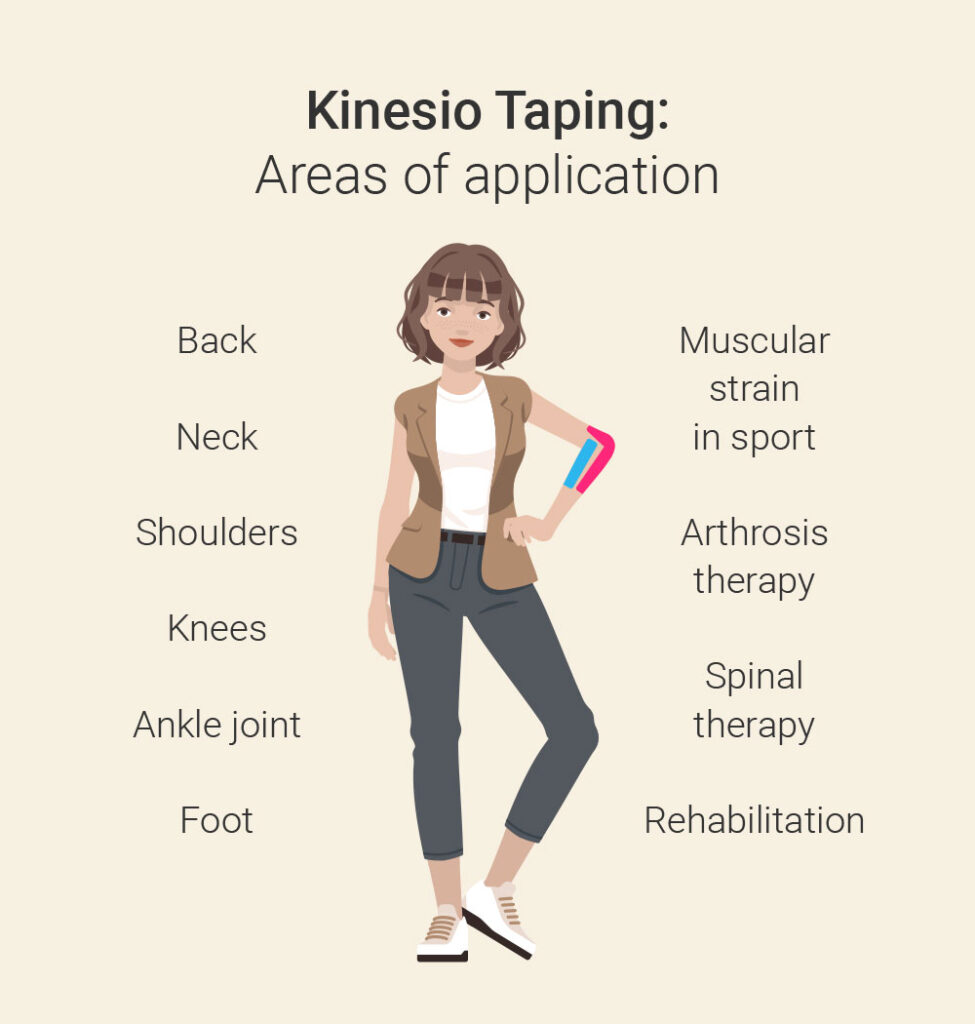
The application depends on the affected area of the body and the specific symptoms. These include:
In cases of muscular tension, uneven strain or persistent poor posture, Kinesio tapes can relieve the affected muscle groups and promote mobility in everyday life. They support more even muscle work, accompany movements of the spine and can help to prevent strain.
Typical areas of application:
- Posture-related complaints of the cervical and thoracic spine
Pain and restricted movement caused by prolonged poor posture in everyday life or at work - Muscle-related back pain
Back pain without structural causes, where tense or overloaded muscle groups are the main issue - Myofascial trigger points
Painful hardened muscle areas that can cause localised or radiating discomfort
Kinesio taping can also support the complex interaction of muscles and joints in the shoulder area. The tapes can stabilise the joints in cases of overload or instability. This allows the arm to continue to move freely.
Typical areas of application:
- Functional shoulder pain
Pain that occurs mainly during certain movements and is not due to structural damage - Overloading of the rotator cuff
Irritation of the shoulder-stabilising muscles, often caused by repetitive or unfamiliar movements - Feeling of instability in the shoulder joint
Uncertainty or ‘giving way’ in the joint, for example after sporting activities or prolonged protective posture - Complaints of restricted shoulder mobility
Restricted movement caused by muscular imbalances or pain-related protective posture
Kinesio tapes can accompany movements during stress on the knee joint and support the guidance of the joint. Taping is useful for athletic stress or stress-related complaints.
Typical areas of application:
- Stress-related knee pain
Pain that occurs mainly when walking, climbing stairs or during sporting activities - Anterior knee pain (patellofemoral pain syndrome)
Complaints in the kneecap area, often caused by incorrect loading or muscular imbalances - Irritation after sporting activities
Temporary pain or feelings of tension after training or competition - Muscular imbalances in the thigh area
Imbalances between the front and back thigh muscles, which can affect knee movement
Kinesio tapes can also support functional stability in the ankle and foot area. Taping is useful, for example, after injuries or during intensive athletic activity.
Typical areas of application:
- Ankle sprains
Complaints after distortions, when the joint is being reintroduced to stress - Feeling of instability in the ankle
Unsteadiness or giving way when walking, running or changing direction during sports - Overuse complaints in the foot area
Pain due to repeated strain, for example in running or jumping sports - Irritation of tendons and ligament structures
Strain-related complaints that can arise from repeated stress
We also use Kinesio taping in sports medicine.
The tapes help stabilise heavily used muscle groups during training and competition. They support muscle movement and can help limit symptoms of overexertion.
Typical areas of application:
- Muscular fatigue
Tension or pain that occurs after intensive or unfamiliar training sessions - Recurring strain complaints
Complaints that reoccur with regular training - Sport-specific strains
Muscle problems caused by repetitive movements, for example in running, throwing or ball sports - Support during return to training
Support in the phase after injuries, when strain is gradually increased
At our private practice for orthopaedics and traumatology in Frankfurt, we also use Kinesio taping as a complementary treatment for osteoarthritis.
The tapes can help to support the interaction of the muscles that guide the joints and relieve stressed joint sections in everyday life. Especially in cases of mild to moderate osteoarthritis, Kinesio taping can help to maintain mobility and better cope with everyday stresses.
Typical areas of application:
- Osteoarthritis in the knee or hip area
Accompanying support for stress-related pain and restricted movement - Osteoarthritis of the shoulder or ankle joint
Support for muscular guidance during everyday movements - Muscular strain in osteoarthritis
Relief for overloaded muscle groups caused by compensatory postures - Accompanying active therapy programmes
Complementary measure during exercise therapy or physiotherapy treatment
Kinesio tapes also serve to support the stabilising muscles along the spine. They accompany movements of the cervical, thoracic or lumbar spine and can help to reduce excessive tension in individual muscle groups. This allows movements to be performed more smoothly and stress-related complaints in everyday life to be better controlled.
For this reason, we use the procedure as a supportive measure in our spine treatment.
Typical areas of application:
- Functional complaints of the cervical, thoracic or lumbar spine
Pain that changes with movement and is not due to structural damage - Muscular imbalances along the spine
Imbalances in the stabilising muscles, often caused by poor posture or uneven strain - Restricted movement of the spine
Restrictions caused by muscular tension or pain-related protective posture - Accompaniment of active forms of therapy
Supplementary support during physiotherapy or manual therapy measures
During rehabilitation, Kinesio tapes can help patients gradually resume movement and make everyday life safer. They support a controlled return to normal movement patterns.
Typical areas of application:
- After orthopaedic injuries or operations
Accompanying support during phases in which mobility is being rebuilt - Reintroduction to everyday stresses
Assistance with activities such as walking, climbing stairs or lifting after prolonged rest - Accompanying physiotherapeutic measures
Supplementary support between therapy sessions - Uncertainty when moving after a prolonged break
Support in returning to normal movements after immobilisation or breaks from stress
Studies confirm the effectiveness of Kinesio Taping
Research shows that Kinesio Taping can effectively complement treatment for certain musculoskeletal conditions. Here is a selection of scientific studies:
A study on the use of Kinesio taping for chronic back pain that is well known among experts was conducted by Paoloni and colleagues. The randomised controlled trial was carried out in 2011 at a clinical facility in Italy and examined patients with chronic, non-specific lower back pain.
As part of the study, the researchers compared various treatment approaches, including Kinesio taping in combination with physiotherapy exercises. The results showed a significant reduction in pain and functional improvements compared to control groups.
The study was published in the European Journal of Physical and Rehabilitation Medicine.
You can read the study results here: Kinesio Taping applied to lumbar muscles influences clinical and electromyographic characteristics in chronic low back pain patients
In a controlled study, Cho and colleagues investigated the influence of Kinesio taping on pain, joint mobility and perception in patients with knee osteoarthritis. The randomised study was conducted in South Korea in 2015 and compared tape application with tension to a placebo taping group.
The results showed that Kinesio taping in combination with active therapy reduced pain when walking, improved the range of motion of the knee joint and had a positive effect on proprioceptive perception.
The results show that Kinesio taping can be a useful complementary measure for alleviating symptoms and promoting joint function in knee osteoarthritis.
The study was published in the Journal of Physical Therapy Science.
Pain in the kneecap area often occurs during activities such as climbing stairs, running or sitting for long periods of time.
A study by Callaghan and colleagues from 2012 investigated the use of Kinesio taping for precisely these complaints. Tape applications were used to support the guidance of the kneecap during movement. The study was conducted in an academic-clinical setting in the United Kingdom.
The results showed a reduction in pain and functional improvements compared to a control group without taping. The authors therefore consider taping to be a useful complementary measure for load-dependent knee pain in the kneecap area.
The results were published in the journal Sports Health in 2012.
You can read the study results here: Effects of taping on pain and function in patellofemoral pain syndrome
The use of Kinesio tapes has also been scientifically investigated in cases of functional shoulder complaints.
In a study conducted in the USA by Thelen and colleagues in 2008, researchers examined whether tapes offer additional benefits to patients with pain-related restrictions in shoulder movement. Tape application was compared with a control group without taping.
The results showed that Kinesio tape led to a reduction in pain intensity and improved active shoulder mobility. Movements above shoulder height in particular were easier to perform after application. The authors therefore classify Kinesio taping as an effective supportive measure for functional shoulder complaints.
The study was published in the Journal of Orthopaedic & Sports Physical Therapy.
More information on this study: The clinical efficacy of kinesio tape for shoulder pain: a randomized, double-blinded, clinical trial
The use of Kinesio tapes has also been investigated in the field of sports medicine. In a study conducted by Vithoulka and colleagues in 2010, researchers analysed how Kinesio taping affects muscle activity and performance parameters during athletic exertion. The study was conducted in Greece.
The results showed that the tapes influenced muscle activity and improved performance during certain types of exercise. In addition, the participants reported a change in their subjective perception of exertion during sporting activity.
The authors therefore classify Kinesio taping as a useful complementary measure in a sports medicine context, especially in cases of high muscular strain.
The publication appeared in the Journal of Strength and Conditioning Research.
Click here for the full study: The effects of kinesio taping on quadriceps strength during isokinetic exercise in healthy non-athlete women
Kinesio taping in Frankfurt: An integral part of various treatments at our practice
As you can see, the use of Kinesio tape has become established as a complementary measure in orthopaedics and sports medicine. Studies show positive effects for selected symptoms, especially in combination with active therapy approaches.
Kinesio taping has long been an integral part of our treatments at our private practice for orthopaedics and traumatology in Frankfurt. We are convinced of its effectiveness for selected indications and have had many excellent experiences with it. It is always applied on the basis of careful orthopaedic diagnostics and our practical experience.
Are you interested in this complementary form of treatment? Then please contact us to make an appointment!
326808139 © Milan | 960209140 © andrew_rybalko | stock.adobe.com