
Many women associate the menopause primarily with typical symptoms such as hot flushes, mood swings or sleep problems. What is often overlooked, however, is bone health. As oestrogen levels fall, bone metabolism also changes. The body breaks down more bone tissue than it builds up. Osteoporosis is therefore one of the most common health complications of this stage of life. Understanding these connections allows you to take early action and reduce the risk of future fractures. In this article, you will learn what happens in the body during the menopause, how osteoporosis develops, and what options you have to strengthen your bones in the long term.

Osteoporosis: Your bones in flux
Bones appear stable and unchanging, yet behind the scenes, remodelling processes are constantly taking place. The body breaks down old bone tissue and replaces it with new. This interplay ensures that your bones remain strong and can withstand the demands of everyday life.
If this balance is disrupted, bone density gradually decreases. The fine internal structure becomes more porous, stability declines and resilience decreases. When bone loss progresses, the condition is referred to as osteoporosis.
Typical consequences of bone loss include:
As bone density decreases, the bone loses its internal stability. Its fine structure becomes more porous, meaning that forces can no longer be absorbed evenly. This significantly increases the risk of fractures.
Even minor stresses such as tripping, bracing oneself with a hand or a slight fall can be enough to cause a fracture. In some cases, so-called spontaneous fractures can even occur without any obvious accident.
The spine, hip and wrists are particularly frequently affected, as these areas are subjected to heavy strain in everyday life and play a vital role in stability and movement.
As bone mass continues to break down, individual vertebrae lose stability and height. They may compress or collapse, causing the shape of the spine to change.
This often results in an increased curvature in the upper back, which becomes visible as a hunched back. At the same time, the upper body leans forwards. As several vertebrae may be affected, the spine shortens overall. Over time, this can lead to a measurable loss of height of up to several centimetres.
These changes usually develop gradually over several years.
Due to the loss of bone mass, the vertebral bodies lose stability and may become deformed or collapse. This often results in small fractures in the bone.
These changes lead to persistent back pain, which can worsen with movement or prolonged standing. At the same time, the spinal alignment is altered. The muscles respond to this with increased tension in order to compensate for the altered load and ensure stability.
This constant tension leads to additional muscular discomfort, which can further exacerbate the pain. Mobility also decreases, as the body attempts to relieve pressure on painful areas.
Over time, the symptoms may worsen and increasingly interfere with daily life.
Pain, instability and a growing sense of uncertainty when moving often lead to those affected becoming less physically active. Many avoid everyday activities for fear of falling or sustaining further injuries.
This reduced activity also affects the muscles. They weaken, which further reduces stability and increases the risk of falling.
Serious fractures, particularly in the hip area, can significantly alter daily life. In many cases, those affected are temporarily or permanently dependent on support, which can considerably limit their independence.
Osteoporosis affects women significantly more often than men. Around one in three women develops reduced bone density or osteoporosis during her lifetime. The risk increases significantly, particularly after the menopause (source: Deutsche Menopause Gesellschaft e. V.).
The menopause: changes that affect more than you might think
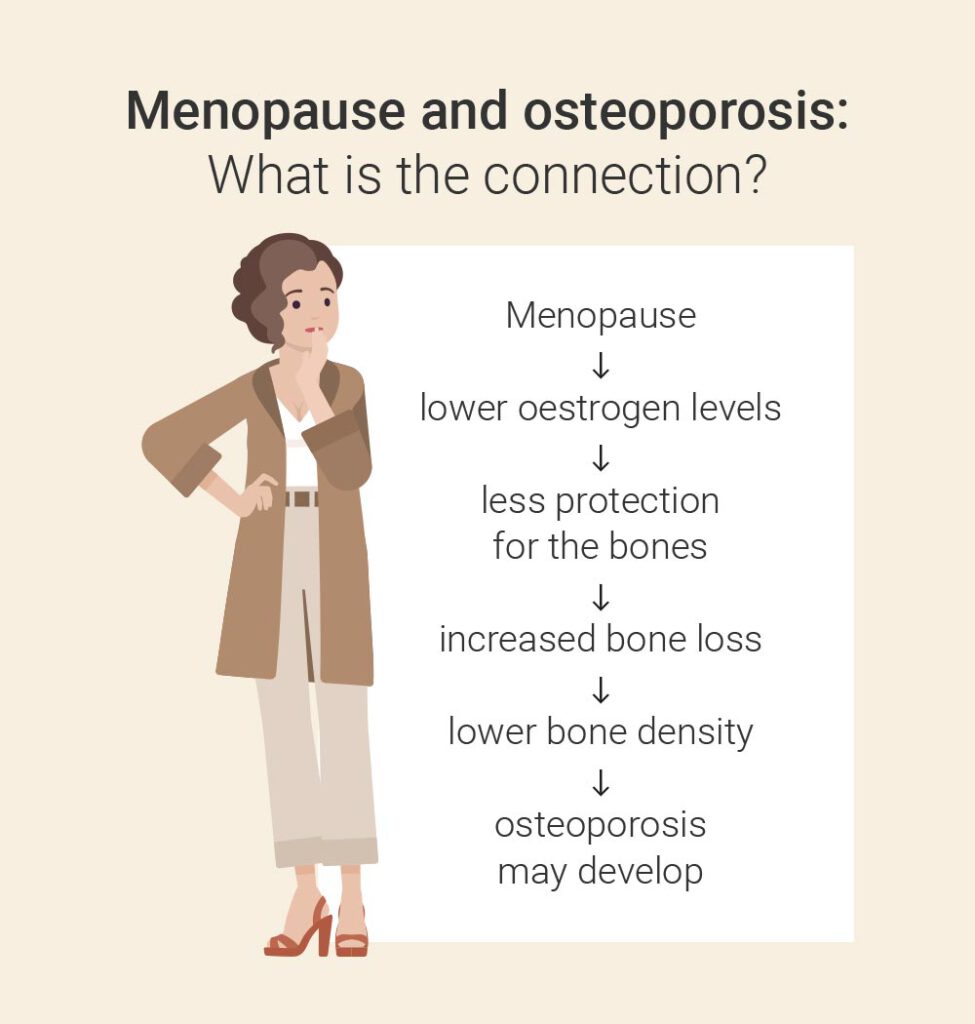
The menopause (climacteric) usually begins between the ages of 45 and 55. During this phase, ovarian function gradually declines. Ovulation becomes less frequent and hormone production changes significantly. In particular, oestrogen levels fall, whilst other hormonal processes also settle into a new balance. Periods initially become irregular and eventually cease altogether (menopause). Pregnancy is then no longer possible.
Oestrogen plays a central role in the body. It influences not only the menstrual cycle, but also metabolism, the condition of the mucous membranes and bone metabolism. When oestrogen levels fall, the body reacts on several levels.
This is particularly evident in the bones. Oestrogen normally inhibits bone loss. When this protection is lost, the balance shifts: the body breaks down more bone substance than it rebuilds. Bone density decreases more rapidly than before.
Consequently, the risk of osteoporosis increases significantly during the menopause.
Menopause: What you can do to prevent osteoporosis
As oestrogen levels drop, the demands on your body also change. Now, more than ever, it is important to actively support bone metabolism and slow down bone loss as much as possible.
Basic measures for strong bones:
Regular physical activity is one of the most important ways to maintain bone health. Mechanical stress stimulates the bones, which helps to preserve bone mass. Activities that involve bearing one’s own body weight, such as strength training, brisk walking, hiking or climbing stairs, are particularly effective.
At the same time, the muscles play a crucial role. Well-trained muscles stabilise the joints and relieve the strain on the bones in everyday life. They help to perform movements in a controlled manner and avoid incorrect loading.
In addition, balance and coordination exercises improve physical confidence. They reduce the risk of falls, which can have serious consequences, particularly in cases of reduced bone density.
A combination of strength, endurance and coordination therefore provides the best conditions for long-term bone stability.
An adequate intake of calcium and vitamin D is crucial for bone health. Make sure to regularly include calcium-rich foods in your diet. These include, above all, milk and dairy products such as yoghurt or cheese, but also green vegetables such as broccoli or kale, as well as nuts and seeds.
Calcium-rich mineral water can also make an important contribution. It’s worth checking the label: some mineral waters contain over 300 mg of calcium per litre and can therefore usefully supplement your daily intake. These are labelled as ‘calcium-rich’.
Vitamin D supports the body’s absorption of calcium. It is largely produced in the skin through exposure to sunlight. Supplementation may be advisable, particularly during the winter months or if you spend little time outdoors.
However, we recommend consulting a doctor.
Certain lifestyle habits can significantly accelerate bone loss. Smoking has a direct impact on bone metabolism and can impair blood circulation and the regeneration of bone tissue.
A persistently low body weight places less strain on the bones, meaning that important stimuli for maintaining bone mass are lacking. Frequent alcohol consumption or an unbalanced diet can also have a negative impact on bone health.
A healthy lifestyle involving sufficient exercise, a balanced diet and avoiding harmful habits therefore plays a key role in slowing down bone loss.
It is also advisable to seek medical advice. A bone density scan can identify at an early stage whether action is needed and what measures are appropriate in each individual case.
The menopause and osteoporosis: measuring bone density, identifying risk
The hormonal changes associated with the menopause increase the risk of accelerated bone loss. A bone density scan helps to identify changes at an early stage and better assess your personal risk.
In DXA (dual-energy X-ray absorptiometry) bone density measurement, bone density is assessed using two X-ray beams of different intensities. These beams pass through the bone, enabling the mineral content to be calculated precisely. This reveals just how dense and stable your bones actually are.
The examination usually focuses on the lumbar spine and the hip. Osteoporotic changes occur particularly frequently in these areas. At the same time, they provide reliable values for assessing the entire skeleton.
The DXA scan not only shows how much bone mass is present, but also classifies the result in comparison to reference values. The T-score plays a key role here. It indicates how much your bone density differs from that of a healthy young adult.
This allows a clear distinction to be made as to whether
- your bone density is within the normal range,
- you have reduced bone density (osteopenia), or
- you already have osteoporosis.
This classification is crucial for assessing your personal risk of bone fractures and for taking appropriate action at an early stage.
For the examination, please lie down comfortably on your back on a couch. No special preparation is required. The only important thing is that you remove any metal objects, such as jewellery, beforehand.
During the scan, please lie still so that the machine can scan the relevant areas of your body.
The entire examination is calm and straightforward. The results can be analysed immediately afterwards, so you will receive an assessment of your bone density promptly.
The T-score is a key measure in bone density testing. It indicates how much your bone density differs from that of a healthy young adult. This reference is considered the optimal state, as bone density peaks during young adulthood.
The value is expressed as a number. A T-score below -1.0 means that your bone density is below the reference value.
The following guidelines apply for classification:
- T-score above -1.0: normal bone density
- T-score between -1.0 and -2.5: reduced bone density (osteopenia)
- T-score below -2.5: osteoporosis
The lower the value, the lower the bone density and the higher the risk of fractures. The T-score helps us to clearly classify the findings and plan the next steps on an individual basis.
It is often advisable to have an initial measurement taken at the start of the menopause or shortly afterwards.
In addition to a bone density scan, a laboratory analysis may also be useful. Certain blood test results provide an indication of how active bone metabolism is and whether there are any potential deficiencies. These include, amongst others, vitamin D, calcium and specific markers of bone formation and resorption. It may also be worth checking your hormone levels.
The combination of bone density measurement and laboratory analysis allows for a comprehensive assessment of your bone health and forms the basis for a personalised prevention or treatment plan.
Treating osteoporosis in Frankfurt: Treatment options with Dr Tabrizi
The treatment of osteoporosis at our practice in Frankfurt has a clear objective: to slow down bone loss, improve stability and reduce the risk of fractures. The appropriate measures depend on the severity of the condition and your individual risk.
If osteoporosis is already present, certain medications can help. These include, amongst others:
- Bisphosphonates (inhibit bone resorption)
- Denosumab (affects bone metabolism)
- Selective oestrogen receptor modulators (act similarly to oestrogen on the bones)
- Parathyroid hormone analogues (promote bone formation)
Early and consistent treatment plays a crucial role in maintaining bone health and safeguarding your quality of life in the long term.
Please feel free to contact us to arrange an appointment for an osteoporosis screening!
408261798 © Kateryna | 1932877712 © andrew_rybalko | stock.adobe.com