
When the shoulders or pelvis are no longer aligned, there is sometimes more to it than just a question of posture. Scoliosis changes the natural shape of the spine: it curves sideways and rotates around its axis at the same time. This misalignment can affect the balance of the back, breathing and mobility. Depending on the progression and severity of the curvature, there are different forms of scoliosis, which differ significantly in their causes and therapeutic approaches. An accurate diagnosis is crucial in order to choose the appropriate treatment and stabilise the spine again.
Impaired balance: what happens to the back in scoliosis
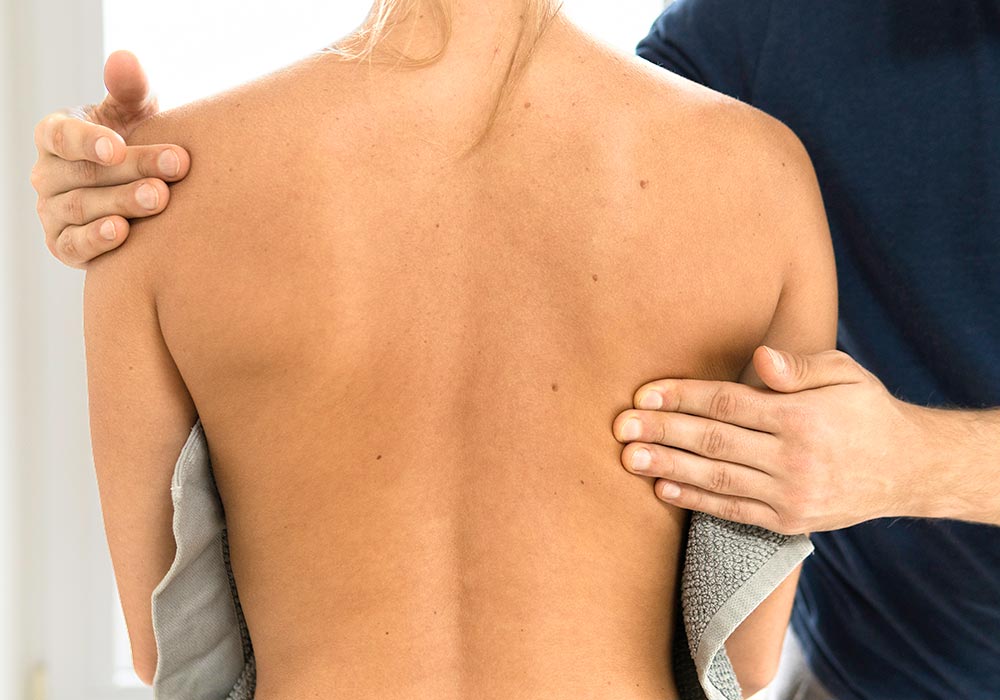
In scoliosis, the spine loses its natural alignment. Viewed from behind, the back is no longer straight but curves to one side. At the same time, the vertebrae rotate around their own axis.
This change can affect the balance of the entire back, as it can also cause the ribs, muscles and ligaments to shift. On one side, the ribs and shoulder blade protrude more, while the other side appears sunken.
The three-dimensional deformation changes the load lines in the back: some sections bear more weight, while others lose stability. This can restrict mobility or create a feeling of imbalance – even if no pain is yet present. Scoliosis therefore affects not only the external shape, but also the complex interaction of the structures that keep the back upright and mobile.
What are the symptoms of scoliosis?
The symptoms associated with spinal degeneration can vary greatly depending on the severity, the affected region of the spine and the age of the person affected. Some changes are hardly noticeable at first, while others are clearly visible in the body image or movement behaviour.
Typical external signs of scoliosis are:
- uneven shoulder height or a protruding shoulder blade
- a crooked iliac crest or an apparently ‘shortened leg’
- asymmetry of the chest, particularly noticeable when bending forward
- a shifted centre of gravity, so that the upper body is not directly above the pelvis
In addition to the visible changes, physical complaints may also develop:
- muscle tension in the back or neck
- unilateral pain caused by incorrect weight distribution
- a feeling of restricted mobility or instability
- faster fatigue when standing or sitting for long periods
In severe cases, scoliosis can deform the chest and thus affect breathing or cardiovascular function.
What causes scoliosis?
There are many causes of spinal curvature, and they depend largely on whether the deformity is congenital or acquired during the course of a person’s life. Here is an overview of possible contributing factors:
This is the most common form. It develops without any identifiable underlying disease. Genetic factors, hormonal influences and an imbalance in the growth of the muscles and vertebrae are thought to play a role.
This form develops during pregnancy. Incomplete or asymmetrical vertebrae cause the spine to curve sideways as the child grows.
In adulthood, the spine can change due to wear and tear. Wear and tear on the intervertebral discs, osteoarthritis or osteoporosis cause the vertebrae to lose their stability and the axis to gradually shift.
In this form, the spine reacts to external stress without being pathologically altered itself. Typical triggers are a difference in leg length, a tilted pelvis or muscular imbalances. To compensate for the imbalance, the back tilts to one side. The curvature therefore develops as a compensatory posture. Once the cause has been identified and treated, the spine can usually straighten up completely again.
What types of scoliosis are there?
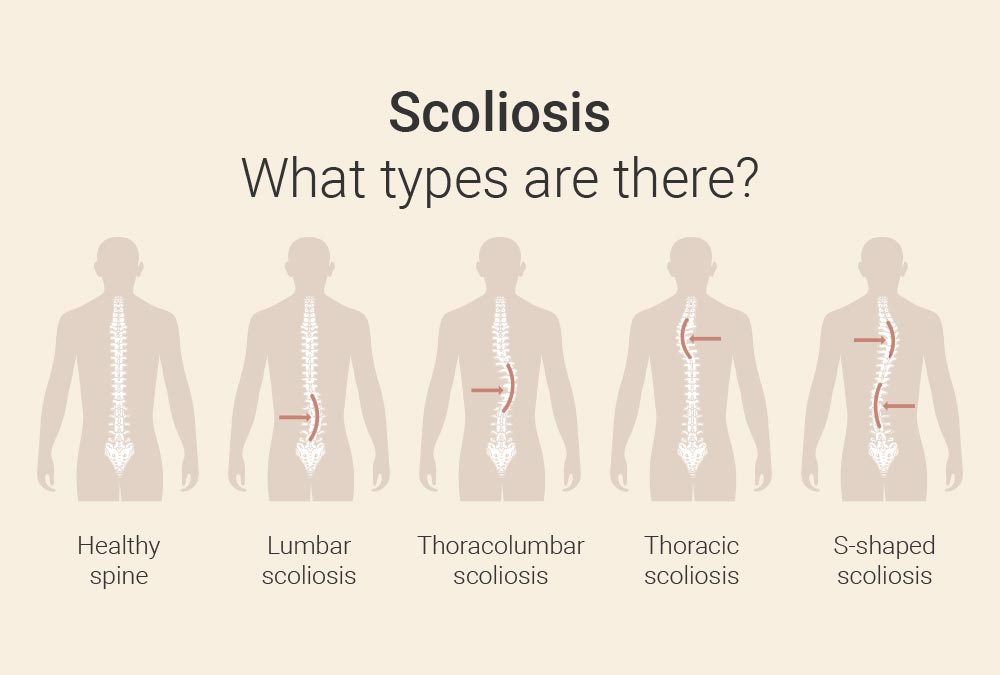
The curvature can occur in different sections of the spine and vary significantly in severity. The decisive factors are where the spine deviates laterally and how severely it twists.
In thoracic scoliosis, the lateral curvature is located in the thoracic spine, i.e. between the seventh cervical vertebra and the twelfth thoracic vertebra. This is one of the most common types of scoliosis and affects the section where the ribs are connected to the spine.
The rotation of the vertebrae causes the rib cage to twist: on one side, the ribs curve outwards more strongly, while on the other side they sink inwards. This asymmetry often manifests itself as a so-called rib hump, which is clearly visible when bending forward.
Many people affected initially only notice uneven shoulder height or a shifted shoulder girdle. Over time, tension, one-sided back pain or a feeling of restricted breathing may develop as the movement of the rib cage changes when breathing in and out.
This form of scoliosis affects the transition area between the thoracic and lumbar spine – i.e. the section where the relatively rigid rib cage transitions into the more mobile lower back. This region is particularly susceptible to misalignment, as two very different movement zones of the spine meet here.
The curvature usually runs diagonally across the lower chest and upper lumbar region, which can cause the axis of the upper body to shift significantly. Typical symptoms include a visible trunk tilt, an asymmetrical waist and a tilted pelvis. Many sufferers also have a unilateral rib or lumbar curvature, which is clearly visible when bending over.
The rotation of the vertebrae can cause uneven strain on the back muscles. Tension and unilateral pain in the lower back are therefore common. In cases of pronounced curvature, the body’s statics also change, which can lead to greater strain on the lumbar spine.
This affects the lower section of the spine, i.e. the lumbar vertebrae. This region bears a large part of the body’s weight and is heavily involved in everyday movements such as bending, turning and straightening up. A misalignment in this area can therefore quickly affect the entire posture.
A typical symptom is a lateral curvature of the lumbar spine, in which the pelvis is visibly tilted. Often, one hip is higher than the other, which changes the gait and leads to asymmetry in the waist. Many affected individuals notice that their clothing fits differently on one side.
The muscles in the lower back often react to this misalignment with tension or unilateral pain as they try to compensate for the imbalance. If the curvature becomes more pronounced, the strain on the intervertebral discs and small vertebral joints can also change. This often results in chronic back pain or premature wear and tear.
In this case, the spine has two opposite curves – usually one in the thoracic region and one in the lumbar region. This form often develops because the body tries to maintain balance. A second curve forms to compensate for the imbalance caused by the first.
Externally, this often makes the posture appear more symmetrical, even though the spine is clearly deformed. Typical signs are uneven shoulder and pelvis positions, a narrower waist on one side or a shifted centre of gravity, which is noticeable when standing or walking.
When bending forward, the double curvature becomes particularly visible – the ribs protrude more on one side, while the lower back shows a corresponding indentation.
The combination of both curves distributes the strain across several sections of the spine, which can cause tension, back pain and limited mobility in the long term.
Types of scoliosis: left-sided or right-sided curvature
In addition to being classified according to the affected sections of the spine, types of scoliosis also differ in the direction of the curvature – i.e. which side the apex of the deformity leans towards.
- Scoliosis with curvature to the right (right convex)
In this variant, the vertebrae rotate to the right. This causes the ribs on the right side to curve backwards and outwards, creating the typical rib hump. At the same time, the left half of the chest rotates inwards, which can restrict breathing on this side. - Left-curved (convex left) scoliosis:
Here, the opposite occurs: the vertebrae rotate to the left and the left half of the ribs curves backwards. The right side also turns inwards. This makes the right half of the chest appear flatter and can restrict breathing on the right side.
The direction of the curvature is crucial for therapy because it determines which side of the body needs to be stretched and which needs to be strengthened. In right-convex scoliosis, the shortening and muscular tension is on the right (convex) side, while the left (concave) side is weakened. Treatment therefore aims to stretch and relax the right torso muscles, while actively strengthening and stabilising the left side. In left-convex scoliosis, the situation is mirrored.
Precise analysis using imaging techniques and posture diagnostics helps to accurately identify these individual differences. This allows the treatment options to be adapted to the respective direction of curvature.
Severity levels of scoliosis: an overview of different forms
Spinal curvature is classified into different severity levels depending on how severely the spine is curved and twisted to the side. The decisive factor for this classification is the so-called Cobb angle, which is measured on an X-ray. It describes the angle between the most severely inclined vertebrae of a curvature and serves as a measure of the severity of the deformity. An overview of the degrees of severity:
The curvature is slight and often only visible upon close inspection. Many affected individuals have no symptoms. Physiotherapy, exercise therapy and regular check-ups are usually sufficient to stabilise posture.
The misalignment is more noticeable, and the shoulders and pelvis may be visibly crooked. Back pain or muscle tension often occur. In addition to physiotherapy, a corset may be necessary to prevent progression, especially during growth.
At this stage, the curvature is clearly pronounced. It can not only change posture, but also affect the function of the lungs, heart and internal organs. Surgical correction may be necessary if conservative therapies no longer ensure stability.
The earlier scoliosis is detected, the better its progression can be influenced. Regular check-ups are crucial, especially in childhood and adolescence when the spine is still growing, in order to take timely countermeasures and avoid further complications as far as possible.
Treatment of various forms of scoliosis by Dr. Tabrizi in Frankfurt
Scoliosis can only be reliably assessed with careful diagnosis and extensive experience. At our private practice for orthopaedics and traumatology in Frankfurt, we are the right people to contact. We analyse your posture and mobility and measure the angle of curvature, e.g. using imaging techniques and physical examination. This enables us to accurately assess the extent of the misalignment.
The subsequent treatment is tailored to the individual cause and severity. It may include physiotherapy, posture training, muscle building, corset therapy or, in severe cases, surgery. This results in a treatment plan that stabilises the spine and provides lasting relief from symptoms.
We take the time to listen and work with you to find the best way to restore balance to your spine.
478511274 © blackday | 826655100 © Tatiana | stock.adobe.com