
In everyday life, joint pain often manifests itself in very different ways. Sometimes it only occurs during certain movements, sometimes at rest or at night. For some people, the symptoms change throughout the day, while for others they remain constant. Sometimes the pain starts in one place and then spreads. As you can see, not all pain follows the same pattern. There can be different causes behind individual symptoms. Read on to find out what these might be.
Joint pain is not always synonymous with joint wear: common causes of joint problems
Many patients automatically associate joint pain with osteoarthritis. However, joint degeneration is not always to blame for the symptoms. A clear distinction helps to classify symptoms realistically and avoid misconceptions.
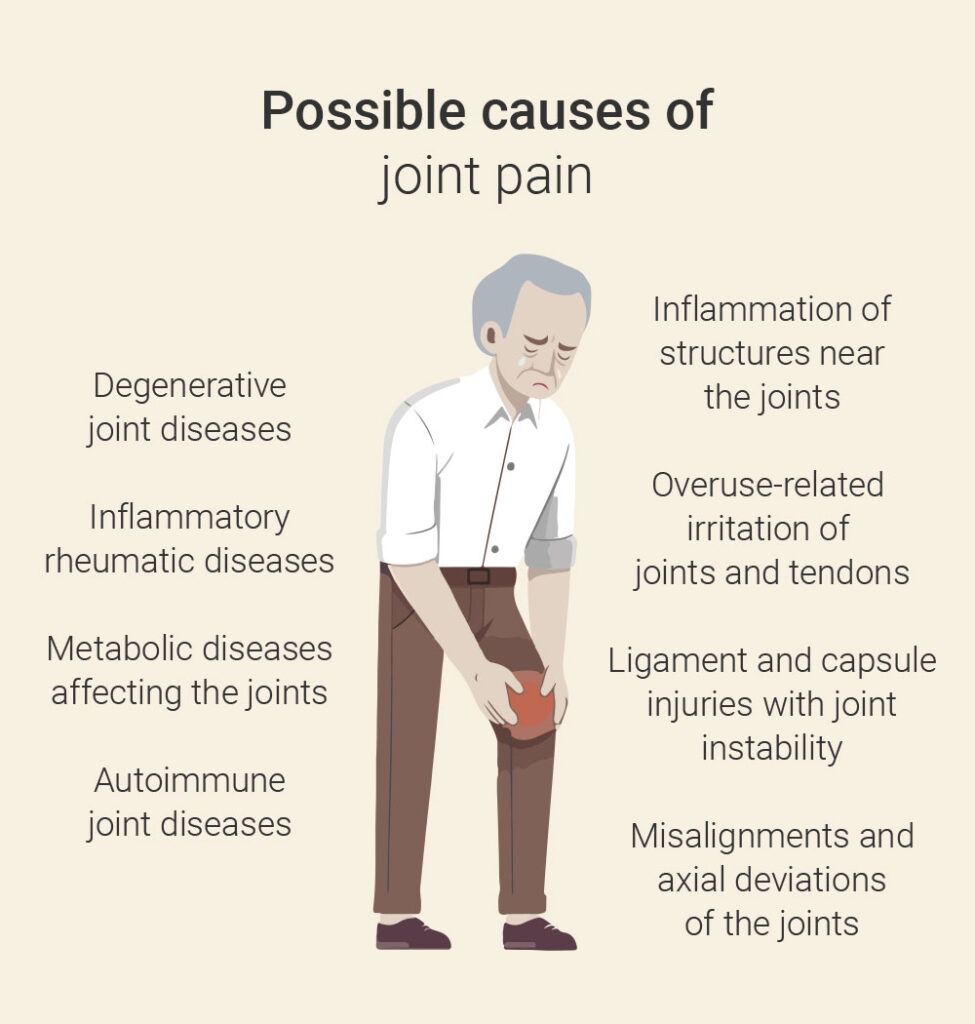
The most common conditions that can cause joint pain include:
- Degenerative joint diseases such as osteoarthritis
- Inflammatory rheumatic diseases such as rheumatoid arthritis
- Metabolic diseases such as gout
- Autoimmune-associated joint diseases such as psoriatic arthritis
- Bone diseases such as osteoporosis
- Inflammation of structures near the joints, such as bursitis
- Overuse-related irritation of joints and tendons
- Ligament and capsule injuries resulting in joint instability
- Malalignments and axial deviations that alter joint load
These conditions can cause joint pain
In this condition, the joint gradually changes due to wear and tear. The cartilage, which normally ensures smooth movement, becomes thinner and loses its protective function. This makes the joint surfaces more sensitive to stress. This process most commonly affects the knees, hips, hands or spine.
The pain is particularly noticeable during movement. Many patients experience discomfort when walking, climbing stairs or after prolonged exertion. The pain often subsides at rest. Another typical symptom is brief stiffness after getting up or after sitting for long periods, which resolves with movement. As the condition progresses, mobility may decrease. In addition, the joint often feels less resilient overall.
The diagnosis is based on a thorough medical consultation and physical examination. The decisive factors are when the pain occurs and which movements trigger discomfort. Imaging techniques such as X-rays or MRI scans reveal typical changes in the joint, such as narrowing of the joint space or bony growths.
Treatment is based on the symptoms and the stage of joint change. The focus is on measures that reduce pain and maintain joint function. These include regular, appropriate exercise, building stabilising muscles and strategies to relieve strain in everyday life. Pain-relieving medication is also used In cases of severe symptoms and advanced changes, surgery may also be advisable.
You can find out more here: Arthrosis therapy in Frankfurt
Unlike wear-related changes, this condition is primarily caused by a malfunction of the immune system. The synovial membrane becomes permanently inflamed, causing pain and swelling. The disease often begins in small joints, such as the fingers or toes, and usually affects both sides of the body at the same time.
The symptoms often occur independently of physical activity. Many sufferers report pronounced morning stiffness that only subsides as the day progresses. This is often accompanied by painful, swollen and overheated joints, as well as fatigue or exhaustion.
Several factors play a role in the diagnosis. In addition to the consultation and physical examination, blood tests provide important information about inflammatory processes or certain antibodies. Imaging techniques make early inflammation visible even before structural damage occurs.
The aim of treatment is to control the inflammation in good time and thus prevent joint damage. Anti-inflammatory drugs and special active substances that intervene in the immune system are used. In addition, exercise therapy and everyday strategies that protect the joints help to maintain mobility.
Further information: Arthritis therapy in Frankfurt
Elevated uric acid levels in the blood cause crystals to deposit in the joints. The body responds to this with a pronounced inflammatory reaction. This particularly often affects the big toe joint, but symptoms can also occur in the knee, ankle or elbow.
The pain usually comes on suddenly and reaches a high intensity within a short time. Those affected describe the joint as very sensitive to pressure, reddened and hot. Attacks often occur at night or in the early hours of the morning. There may be longer symptom-free periods between gout attacks, especially at the onset of the disease.
In addition to a clinical examination, the diagnosis includes blood tests to determine the uric acid level. In certain cases, uric acid crystals can also be detected directly in the joint. Imaging techniques support the diagnosis.
Treatment has two objectives: rapid relief of the acute attack and long-term reduction of uric acid levels. Anti-inflammatory drugs are used in acute cases. In addition, long-term medication is important. Dietary and lifestyle adjustments can also help prevent further attacks.
This form of joint disease occurs in connection with psoriasis. Inflammatory processes affect not only the skin, but also the joints and areas where tendons and ligaments attach to the bone. This causes discomfort not only in the joint itself, but also in its immediate vicinity.
Pain, swelling and limited mobility are the main symptoms. Typical symptoms include sausage-shaped thickened fingers or toes and discomfort that can occur both at rest and during movement. In some affected individuals, joint problems precede skin changes.
The diagnosis is based on a combination of several factors. In addition to a physical examination, the patient’s history of known skin changes and imaging procedures provide important clues. Blood tests help to rule out other inflammatory joint diseases.
Treatment depends on the severity and progression of the disease. The aim is to control the inflammation and maintain joint function. Anti-inflammatory drugs and agents that interfere with the immune system are used. In addition, exercise therapy and individually tailored measures support the everyday life of those affected.
This condition causes changes in bone stability. Bone density decreases, making the skeleton as a whole more susceptible to fractures. The joints themselves usually remain unchanged, but pain can still occur. In this context, pain can be attributed to misalignments or changes in stress as a result of bone fractures.
The symptoms often develop inconspicuously. Many affected individuals do not experience any pain for a long time. Only when so-called spontaneous fractures occur, for example in the vertebral bodies, do back pain or restricted movement suddenly appear. A reduction in the height of the vertebrae puts greater strain on neighbouring joints.
The diagnosis is primarily based on bone density measurements. We also take into account risk factors such as age, hormonal changes or previous bone fractures. Imaging techniques help to identify existing fractures and rule out other causes.
The aim of treatment is to slow down further bone loss and reduce the risk of fractures. This includes drug therapies as well as adequate calcium and vitamin D intake. Exercise and muscle training support the stability of the skeleton and help to better distribute the load on bones and joints.
Further information: Osteoporosis therapy in Frankfurt
Not all joint problems are caused by structural disorders. Repeated strain, unfamiliar movements or uneven stress can also lead to irritation, which may be accompanied by pain in the joint or adjacent tendons.
The problems usually occur in response to stress and intensify with certain movements. The symptoms often subside at rest. Swelling or signs of inflammation are often absent or not very pronounced.
The diagnosis is made on the basis of the patient’s medical history and a physical examination, which reveals typical stress-related pain and restricted movement. Imaging techniques are mainly used to rule out structural damage.
The aim is then to relieve the irritated tissue and avoid overuse. The focus is on adapted exercise, physiotherapy measures and temporary rest. In certain cases, anti-inflammatory medication or measures such as kinesio taping are used.
Injuries to ligaments or the joint capsule often occur after accidents, twisting injuries or repeated incorrect loading. Older injuries that have not fully healed can also lead to long-term problems. The joint loses stability, which affects its load-bearing capacity.
Typical symptoms include pain during movement or exertion and a feeling of instability in the joint. Some affected individuals report a feeling of giving way or buckling, especially during sporting activities or on uneven ground. Swelling may occur, but does not necessarily persist.
Diagnosis involves a physical examination and functional tests. Imaging techniques such as MRI help to visualise ligament or capsule damage and assess the extent of instability.
Treatment depends on the severity and the structure affected. Stabilisation through muscle building, physiotherapy, bandages, etc. are useful. In cases of severe instability or persistent symptoms, surgical treatment may also be necessary.
More on this: Treatment of orthopaedic injuries in Frankfurt
Changes in the leg or joint axes affect the distribution of stress in the joint. Over time, this leads to increased pressure zones, which can cause pain even if the cartilage is still intact. Common examples are bow legs or knock knees, as well as misalignments in the foot or knee area.
The symptoms usually develop gradually and occur mainly during exertion. Those affected often report unilateral pain or faster fatigue of the affected joint. In the course of the disease, adjacent structures such as tendons or bursae may also become irritated.
Diagnosis involves a detailed examination of body statics and imaging techniques that reveal axial relationships and joint stress. This classification is important for the early detection of consequential damage.
Treatment depends on the extent and consequences of the misalignment. Conservative measures are the first line of treatment. In cases of pronounced axial deviations or persistent symptoms, surgical correction may also be considered.
Diagnosis and treatment of joint pain with Dr. Tabrizi in Frankfurt
Joint pain can have many different causes. In order to help you, a careful diagnosis is required. With various examinations in our private practice for orthopaedics and traumatology in Frankfurt, we can find out the cause of your joint pain and develop a treatment plan that suits your personal situation.
We are here for you! Simply contact us to make an appointment! You can also do this via Doctolib, our online appointment booking tool.
303316204 © Dragana Gordic | 1769334519 © Andi | stock.adobe.com