

Osteoarthritis is a widespread joint condition and a common cause of limitations in everyday life. When the quality of the joint cartilage deteriorates, the affected joint can no longer absorb stress as effectively as it once did. Many patients then ask which treatment can relieve pain and help preserve mobility for as long as possible. Conventional measures such as physiotherapy are not always enough to control the symptoms satisfactorily. In such situations, treatment directly at the affected joint can be useful. Intra-articular infiltration delivers a suitable preparation into the joint space by injection. This can calm irritation and relieve pain. Below, you will find out what you need to know about the treatment.

In this article, you will learn
- what intra-articular infiltration is
- which active substances may be considered for osteoarthritis
- which joints may be suitable for treatment
- how to assess the effect, procedure and possible side effects
What is intra-articular infiltration?
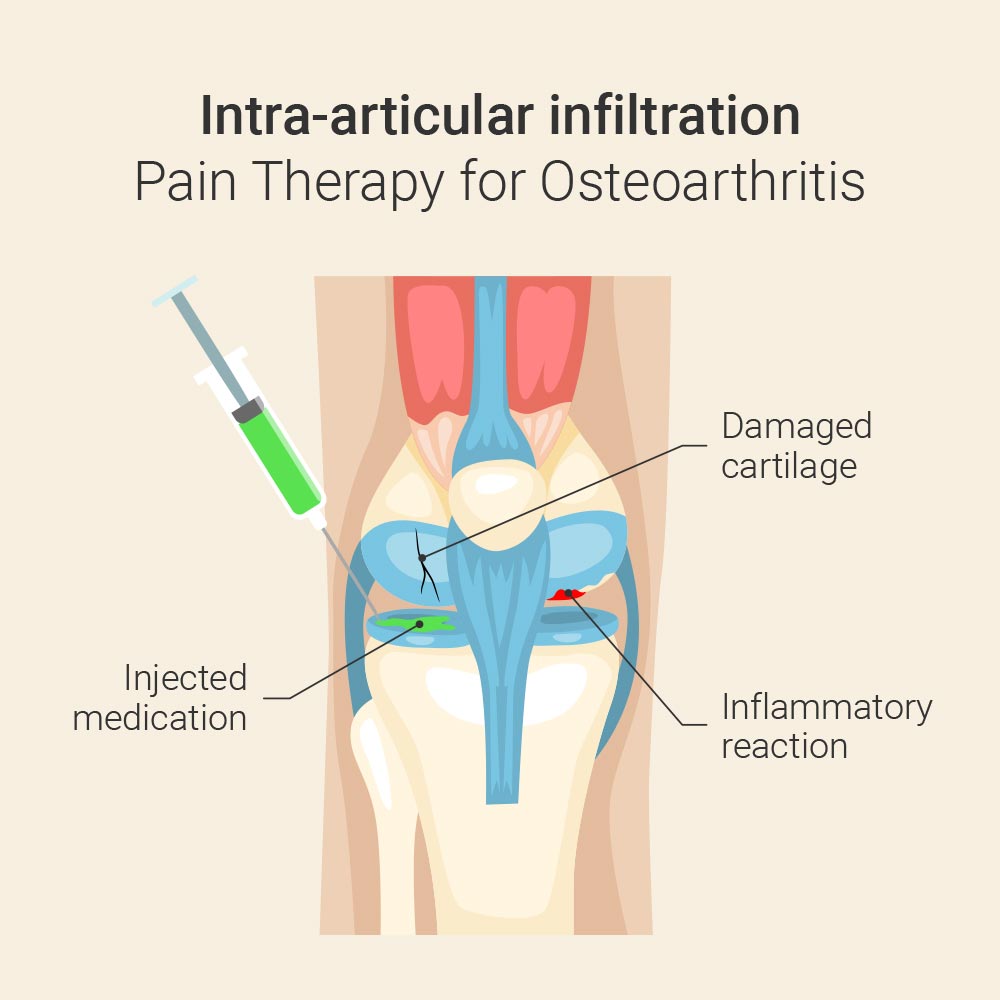
In this treatment, we inject a suitable medication or preparation directly into the joint space. “Intra-articular” means that the injection takes place inside a joint. This allows the therapeutic substance to reach exactly the area where it is intended to take effect.
In cases of osteoarthritis, such a joint injection can be useful when irritation, inflammation or pain in the joint plays a role alongside cartilage wear. The aim is to calm the joint, relieve symptoms and support mobility.
Which preparation is suitable depends on your individual findings, the affected joint and the treatment goal. We therefore select the active substances individually and tailor the infiltration therapy to your symptoms.
When is intra-articular infiltration considered for osteoarthritis?
Not every case of joint pain requires an injection straight away. First, we assess where the symptoms are coming from, how severely the joint has changed and which treatments you have already tried. These may include exercise therapy, physiotherapy, anti-inflammatory medication or everyday adjustments.
Intra-articular infiltration may be considered when these measures do not help sufficiently or when a joint repeatedly reacts with irritation. Typical situations include load-dependent pain, recurring signs of inflammation, swelling or noticeably restricted mobility, for example when walking or climbing stairs.
Which active substances can be used in infiltration therapy?
Depending on the symptoms, osteoarthritis stage and treatment goal, different active substances may be considered.
In our private practice for orthopaedics and traumatology in Frankfurt, we use:
During an acute irritation or inflammation, an osteoarthritic joint can cause significantly more symptoms than usual. In such phases, the main issue is not only wear and tear, but above all the inflammatory reaction within the joint.
Cortisone is a powerful anti-inflammatory active substance. Injected directly into the affected joint, it can slow inflammatory processes and reduce the formation of pain and inflammatory messenger substances.
This can help cortisone break an acute pain phase. Many patients benefit because pain decreases, the joint becomes calmer and everyday movements become easier again.
In osteoarthritis, the joint fluid can also change. It loses part of its natural lubricating and shock-absorbing function. As a result, movements no longer run as smoothly. Consequently, the joint may feel stiff or sensitive to load.
Hyaluronic acid is a natural component of joint fluid. It helps joint surfaces glide more effectively and cushions stress within the joint. As part of infiltration therapy, we can introduce hyaluronic acid directly into the joint space.
The aim is to improve gliding ability, reduce mechanical stress and support mobility in everyday life. Hyaluronic acid does not act like a conventional painkiller; instead, it addresses joint function.
With chronic joint symptoms, the focus is often not only on short-term pain relief. Many patients also want a therapy that can support the body’s own regenerative processes and positively influence the irritated joint environment.
PRP stands for platelet-rich plasma. It is obtained from a small amount of the patient’s own blood and contains concentrated platelets with growth factors. These endogenous messenger substances can support repair processes in the tissue and regulate inflammatory reactions in the joint.
During a PRP infiltration, we inject the prepared plasma directly into the affected joint. The substances it contains can reduce irritation, support the joint environment and stimulate natural regeneration.
PRP can be a useful option, especially in early to moderate stages of osteoarthritis, if you are looking for a biological complement to conventional pain therapy.
You can find more detailed information about this procedure here: PRP therapy for osteoarthritis: how does the procedure work?
Which infiltration is useful for osteoarthritis can only be decided after a careful examination. We take into account, among other things, whether your joint is acutely irritated, whether load-dependent symptoms are the main issue or whether regenerative approaches may be suitable. This means we do not simply select an active substance; we tailor the treatment specifically to your joint, your symptoms and your personal treatment goals.
Which joints are suitable for intra-articular infiltration?
Infiltration therapy can generally be considered for joints in which osteoarthritis, irritation or load-dependent pain restrict mobility and everyday function. We particularly often treat joints that are regularly placed under significant strain when walking, gripping, lifting or rotating.
Typical areas of application include:
An injection into the knee for gonarthrosis is one of the most common applications. The knee carries a large proportion of body weight and often reacts sensitively to climbing stairs, standing up, longer walking distances or loading after periods of rest.
In hip osteoarthritis, infiltration can help relieve symptoms when walking, rotating the hip or standing for longer periods. Because the hip joint lies deeper anatomically, we often perform the injection under ultrasound guidance.
Osteoarthritic or inflammatory irritation in the shoulder can make many everyday movements difficult, such as getting dressed, reaching overhead or sleeping on the affected side. An injection can help calm the joint and make movements easier again.
The ankle has to absorb high forces with every step. After injuries, in cases of incorrect loading or osteoarthritic changes, infiltration can help reduce pain and improve load-bearing capacity when walking.
Small joints can also lose significant function due to osteoarthritis. If gripping, writing, opening bottles or other fine motor movements cause pain, injection therapy may help support hand function in everyday life when the indication is appropriate.
Whether a joint injection is useful is something we always decide after examination and assessment of the findings. We take into account which joint is affected, how advanced the osteoarthritis is and which active substance suits your personal situation.
How does infiltration therapy work?
The process always begins with an orthopaedic examination. We assess which joint is affected, how mobile it is and which symptoms occur in everyday life. Previous therapies, possible pre-existing conditions and available X-ray, MRI or ultrasound findings can also be included in the decision.
If infiltration is appropriate, we prepare the treatment carefully. We thoroughly disinfect the skin and choose the suitable injection site. If needed, we use ultrasound to visualise the joint more precisely and place the preparation accurately into the damaged joint space.
The injection itself usually takes only a few seconds. Many patients find the injection well tolerated. Afterwards, we discuss what you should pay attention to over the next few hours. In most cases, it is advisable to rest the treated joint somewhat on the same day and initially avoid sport, heavy strain or longer walks.
As a rule, you can leave the practice shortly after the treatment.
Infiltration therapy for osteoarthritis: when does it start working and how long does it last?
How quickly a joint injection takes effect cannot be stated in general terms. The most important factors are the active substance used, the treated joint, the stage of osteoarthritis and how strongly the joint is currently irritated. Everyday load also influences how long the effect lasts.
With this active substance, the anti-inflammatory effect is the main focus. Relief therefore often sets in comparatively quickly, usually within a few days. Especially in an acutely irritated or inflamed joint, the treatment can help calm the pain and irritation phase. Depending on the findings, the effect usually lasts for several weeks.
Here, the effect usually develops gradually because the treatment does not work like a conventional painkiller. Instead, the preparation supplements the joint fluid, improves gliding ability and reduces mechanical stress in the joint. Many patients notice after a few weeks that movements become easier and load-dependent symptoms decrease. The effect can last for several months.
With this biological procedure, the body works with its own growth factors. The prepared plasma can support the irritated joint environment and stimulate regenerative processes. Accordingly, the effect usually does not appear immediately, but over several weeks. The effect often lasts for several months, in some cases even up to a year. However, the duration and strength of the effect depend on the individual findings, the stage of osteoarthritis and everyday load.
Intra-articular infiltration can relieve pain and improve mobility, but it does not replace a comprehensive osteoarthritis concept. It cannot permanently eliminate joint wear itself. That is why, if necessary, we combine injection treatment in our orthopaedic practice in Frankfurt with other elements of osteoarthritis therapy.
Are there any side effects?
Intra-articular infiltration is an established procedure in orthopaedic pain therapy. We perform joint injection treatments regularly and with great care. Nevertheless, transparent patient information also includes pointing out that, as with any injection, temporary symptoms or rare complications can occur.
Most reactions are mild and subside after a short time.
Possible side effects include:
The skin and tissue may react sensitively for a short time.
The treated joint may feel unusual for a few hours.
In rare cases, a haematoma may develop as a result of the puncture.
The joint may react somewhat more strongly for a short time, especially if it was already irritated.
Very rarely, germs can enter the joint. This is why we pay close attention to thorough disinfection, sterile working methods and a clear medical indication.
If severe pain, pronounced swelling, redness, overheating or fever occurs after the treatment, please contact us promptly.
Intra-articular infiltration for osteoarthritis: your experts from Team Dr. Tabrizi in Frankfurt
Osteoarthritis cannot be reversed, but its symptoms can often be influenced effectively. The decisive factor is which treatment suits the stage of the disease, the affected joint and your personal everyday demands. Intra-articular infiltration can help calm pain phases, promote mobility and delay surgical measures for as long as possible.
In our private practice for orthopaedics and traumatology in Frankfurt, we take time for careful diagnostics and a realistic assessment of your symptoms. We evaluate whether a joint injection is useful for you, which active substance may be suitable and how the treatment can fit into a comprehensive osteoarthritis concept.
Would you like to have your joint symptoms assessed by an orthopaedic specialist? Then book an appointment at our practice!
Have your joint symptoms assessed
Appointment for osteoarthritis treatment in Frankfurt
Would you like to find out whether intra-articular infiltration may be suitable for your osteoarthritis symptoms? At our private practice for orthopaedics and traumatology in Frankfurt, we examine your joint carefully and discuss the appropriate next steps with you.
584339931 © methaphum | 1967905217 © Yumagema | stock.adobe.com